This API is used to notify financial institutions and token requestors when tokens are provisioned or when the state of a token change.
| Endpoint | Usage |
|---|---|
| /token/state/provisioned | Notification to inform FI that the token was provisioned to their account. |
| /token/state/changed | Notification to inform FIs and TRs that token state has changed. |
PAT uses standardized message flows to deliver notifications to Financial Institutions and Token Requestors. These flows ensure reliable and consistent notification delivery.
During provisioning of tokens by the token requestor, the financial institution can receive a notification with the real account number that is tokenized.
Token requestors can use the Token Requestor API or batch tokenization to provision tokens.
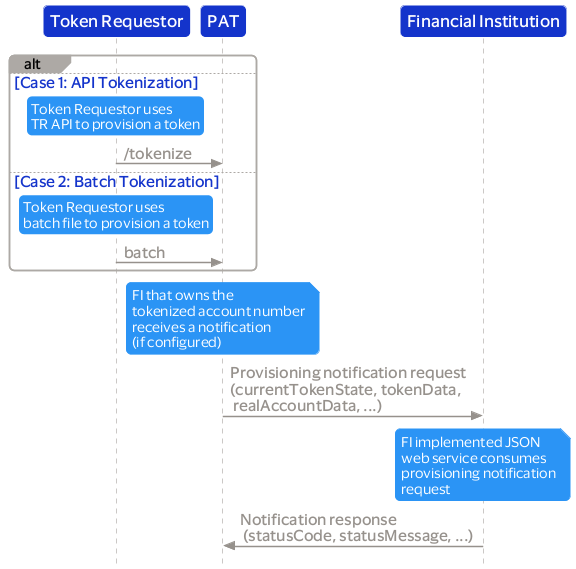
PAT provides comprehensive notification capabilities to keep financial institutions and token requestors informed about token state changes. These notifications ensure all parties are aware of important token lifecycle events.
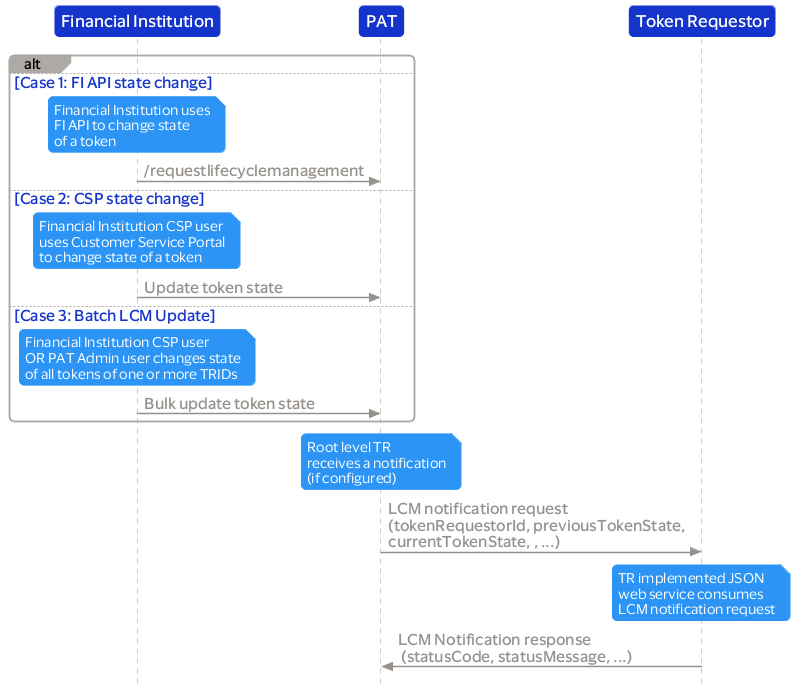
Financial institutions can change the state of tokens that are linked to their real account numbers. Token state changes can be initiated using the Financial Institution API, Customer Service Portal or batch lifecycle management. The token requestor that owns the linked token can receive a notification. If the token requestor is part of a requestor chain, then the notification is sent to the root level token requestor.
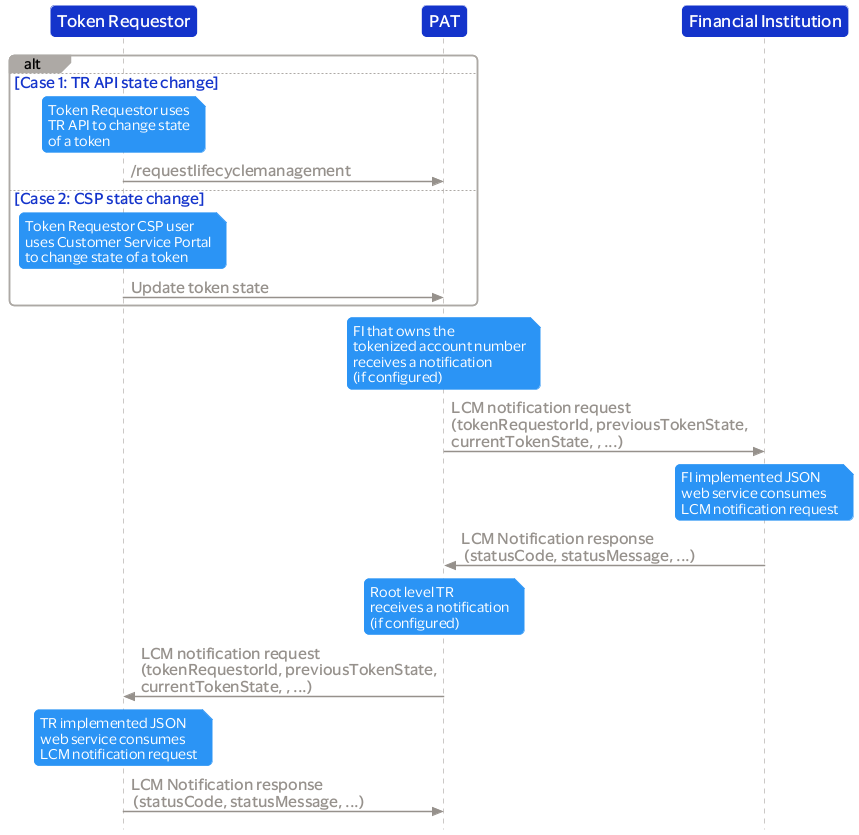
Token requestors can change the state of the tokens they own. Token state changes can be initiated using the Token Requestor API or Customer Service Portal. The financial institution that owns the linked real account number can receive a notification.
This section includes detailed information about the API Response fields statusCode and statusMessage.
{
    "messageId": "6fdf4f09-7fbb-48ae-be1e-ac412a2949a7",
    "conversationId": "aa3a5f54-6eb2-4714-aea3-9f525353cbd7",
    "statusCode": "0000",
    "statusMessage": "Success.",
    "stateChangeReasonCode": "INITIATED_BY_REQUESTOR"
}
| HTTP Code | statusCode | statusMessage | Applicable Message |
|---|---|---|---|
| 200 | 0000 | Success. | - |
| 400 | 1301 | Invalid request. The data field is not in the correct data type format or length or pre-defined values or the required data field is missing. | - |
| 500 | 1300 | Unknown internal server error. Try again later. | - |
| 500 | 1399 | Unknown error. | - |
 Start a Project
 API Overview
 API Reference